
Contacts
Get in touch
Close

Contacts

Akademijos g. 4
Vilnius, Lietuva, LT-08412

+370 64012261

info@cybora.tech

Image Synthesis & Computer Vision Applications

Image Synthesis & Computer Vision Applications

Visual data is often an untapped goldmine. For SMBs, our Computer Vision applications provide affordable automation for physical security and inventory management. Using standard camera hardware, we implement AI that can count stock, recognize unauthorized entry, or even monitor workplace safety protocols, giving small business owners eyes everywhere without the cost of 24/7 security personnel.

For Enterprise organizations, we push the boundaries with Image Synthesis and advanced vision analytics. Image synthesis allows us to create “Synthetic Data” to train AI models in environments where real data is scarce or sensitive (such as medical imaging or classified infrastructure). Our Computer Vision solutions at the enterprise level are used for high-speed quality control in manufacturing, facial recognition for secure facility access, and satellite imagery analysis for logistics. These applications are designed to be “Edge-ready,” meaning the processing happens locally on the device for maximum speed and data privacy, ensuring that large-scale operations remain secure and compliant with international privacy standards.

Watch video Soon Watch video Soon

Our Computer Vision and Image Synthesis services allow your systems to see, interpret, and even create visual information. From automated quality inspections on a factory floor to generating synthetic datasets for secure AI training, we transform visual inputs into actionable business data, enhancing both security and operational efficiency.

How it Works: We deploy specialized neural networks that analyze video or image feeds in real-time, identifying objects, patterns, or anomalies and triggering automated workflows based on what the “AI sees.”

how it worksEverything you need to know about

Artificial Intelligence (AI) is a field of computer science dedicated to creating systems capable of performing tasks that typically require human intelligence. This includes things like reasoning, learning from past experiences, understanding language, and recognizing patterns.

Think of it this way: while traditional software follows a strict “if this, then that” script, AI is designed to process data and make decisions or predictions more dynamically.

The best way to visualize this is through a “nesting” concept. Machine Learning (ML) is a subset of AI.

  • AI is the broad vision of machines acting intelligently.

  • Machine Learning is the specific method used to achieve that vision by training algorithms on large datasets.
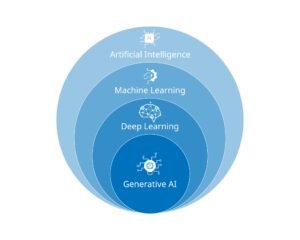
Instead of being manually programmed with specific rules, an ML model “learns” by identifying patterns in data. For example, if you show an ML model thousands of photos of cats, it eventually learns to identify a cat on its own without you telling it to look for “pointed ears” or “whiskers.”
AI relation to Generative Models subset diagram

This is the “million-dollar question,” and the reality is nuanced. AI is transforming the job market rather than simply erasing it.

  • Automation: AI is excellent at handling repetitive, data-heavy, or predictable tasks (like data entry or basic customer service).

  • Augmentation: In most fields, AI acts as a “co-pilot.” It helps doctors diagnose diseases faster or assists coders in writing basic script blocks, allowing humans to focus on high-level strategy and creativity.

  • New Roles: Just as the internet created jobs like “Social Media Manager,” AI is creating new roles like AI Ethicists, Prompt Engineers, and Data Labelers.

While some displacement is occurring, the historical trend with new technology is that it shifts the type of work humans do rather than eliminating work entirely.

AI is generally categorized in two ways: by capability and by functionality.

Categorization by Capability

  1. Narrow AI (Weak AI): Designed for a specific task (e.g., Siri, facial recognition, or Netflix recommendations). This is the only type of AI that currently exists.
  2. General AI (Strong AI): A theoretical AI that can perform any intellectual task a human can. We aren’t there yet.
  3. Super AI: A hypothetical level of AI that surpasses human intelligence across all fields.

pricingSimple and flexible.
Only pay for what you use.

Project based
Great for private individuals and quick solutions
Limited time
Single project
Agile development
Project support time
Contact
Popular
SMB
14 days free period
Up to 12 hours per month
3 Projects
Audit workspace
GRC workspace
Awareness trainings
ICT Monitoring
AI Automation
MLP Automation
Security Controls
BCP Management
Unlimited AI support
Contact
Enterprise
Great deals for the Enterprise solutions
All SMB
Up to 20 hours per month
Unlimited Projects
Unlimited AI support
Contact
Hey there! Ask me anything!