

The Strategic Imperative: Boardroom Accountability and Article 21
The advent of the NIS2 Directive and the looming threat of quantum computing have fundamentally shifted cybersecurity from a technical “IT problem” to a core business risk. Under Article 21, cybersecurity is no longer a matter of voluntary hygiene but a mandatory management obligation. This shift centers on Article 21, which mandates that management boards must approve and oversee risk-management measures. Crucially, the directive introduces potential personal liability for top-level management, including the possibility of criminal sanctions for gross negligence in overseeing these obligations. In this new regulatory landscape, cybersecurity resilience is a direct prerequisite for legal standing and an organization’s long-term viability in the European market.
Management Obligations under Article 21
The following ten core risk-management measures are mandated for all “essential” and “important” entities. To meet the baseline of “basic cyber hygiene,” these must integrate Zero-trust principles, network segmentation, and Identity and Access Management (IAM). For executive leadership, these are the primary defense against charges of gross negligence:
- Risk Management Strategies: General assessments to identify and mitigate threats.
- So What? Preservation of Market Valuation: Proactive risk identification prevents the catastrophic devaluations that follow unmanaged breaches.
- Incident Handling and Reporting: Procedures for managing and notifying authorities of “significant incidents.”
- So What? Regulatory Standing: Efficient reporting demonstrates operational control and prevents the compounding costs of regulatory fines.
- Business Continuity: Planning for backup management, disaster recovery, and crisis management.
- So What? Revenue Resilience: This directly protects the organization’s ability to fulfill customer contracts and maintain cash flow during disruptions.
- Supply Chain Security: Ensuring the security of the relationship between the entity and its direct suppliers.
- So What? Third-Party Risk Containment: Limits the “ripple effect” of vendor failures, protecting the organization’s operational integrity.
- Supplier Management: Specific focus on service providers and software vendors.
- So What? Intellectual Property Protection: Protects proprietary data and trade secrets residing in external environments.
- Continuous Improvement: Ongoing evaluation and updates to security posture.
- So What? Future-Proofing: Ensures the organization evolves ahead of emerging threats like quantum-enabled decryption.
- Cybersecurity Training and Awareness: Basic cyber hygiene training for employees and management.
- So What? Mitigation of Litigation Risk: Documented training is a primary defense against claims of organizational negligence.
- Robust Cryptography: Implementation of encryption and post-quantum planning.
- So What? Digital Trust Maintenance: Essential for the long-term confidentiality of sensitive data and the integrity of digital transactions.
- Access Controls and Asset Management: Policies for system access (IAM) and tracking assets.
- So What? Insider Threat Mitigation: Prevents unauthorized internal movement and ensures clear visibility into the organizational attack surface.
- Multi-Factor Authentication (MFA): Implementation of multi-layered identity verification.
- So What? Defense Against Credential Theft: Provides a baseline defense that is now a regulatory expectation for all management-approved frameworks.
Supervision and Reporting Classes
The NIS2 Directive applies to 18 critical sectors, distinguishing between two entity classes with varying levels of oversight:
| Feature | Essential Entities | Important Entities |
| Supervision Type | High-level, proactive supervision by authorities. | Lighter, reactive supervision (typically post-incident). |
| Reporting Requirements | Stringent, immediate reporting for significant incidents. | Mandatory reporting; thresholds may vary by sector. |
| Sectors | High Criticality: Energy, Transport, Health, Water. | Critical: Manufacturing, Food, Postal, Chemicals. |
While Article 21 sets the baseline, the most significant technical shift lies in the upcoming cryptographic transition.
The Quantum Horizon: EU Planning Timelines (2030–2035)
The strategic threat known as “Harvest Now, Decrypt Later” involves adversaries capturing encrypted data today with the intent of decrypting it once quantum computers reach maturity. For organizations with long-lived systems or data that must remain confidential for decades, the quantum transition is a current planning requirement. The EU has established a tiered transition timeline for Post-Quantum Cryptography (PQC) to protect regional digital sovereignty.
Operationalizing the PQC Timeline
The transition to PQC follows two primary milestones established by EU targets:
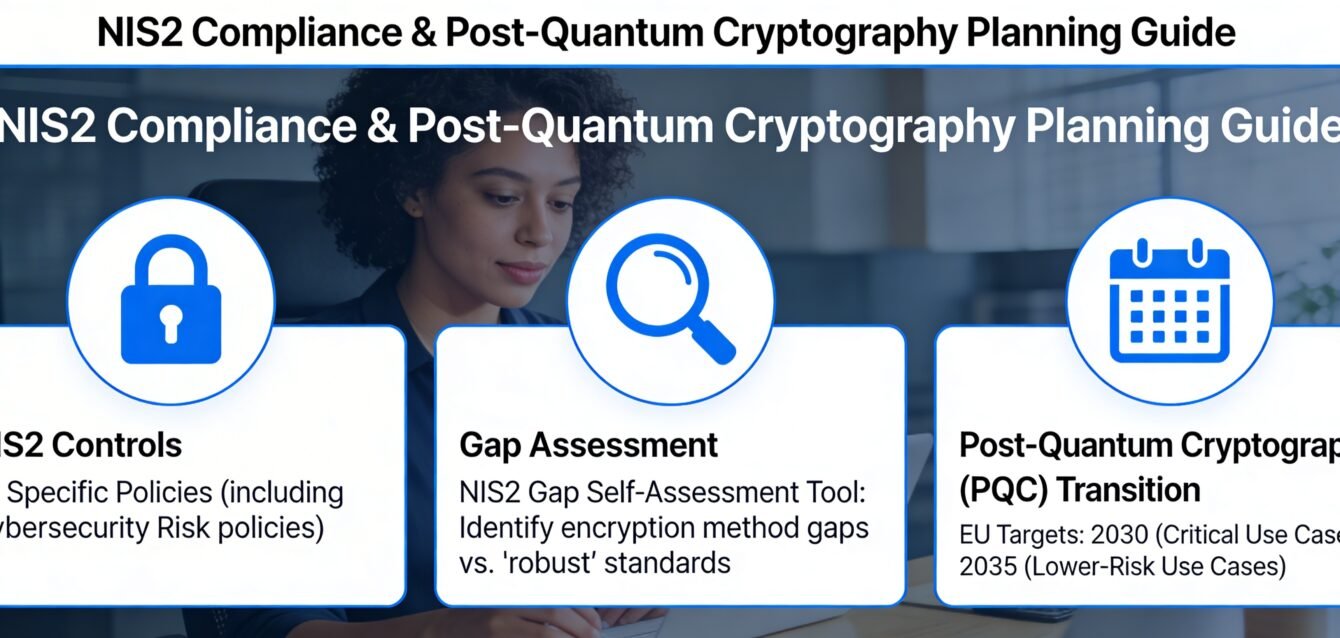
- 2030 Target: Critical Use Cases. By this date, all “critical use cases” must have transitioned to post-quantum standards. This involves identifying systems where the data’s “shelf-life” extends beyond 2030 and upgrading controls to prevent future decryption.
- 2035 Target: Lower-Risk Use Cases. By 2035, the requirement for robust cryptography extends to all remaining lower-priority or lower-risk systems, ensuring a comprehensive, quantum-resistant architecture across the European digital economy.
Cryptographic Robustness and Digital Trust
Under NIS2, “robust cryptography” is a moving target. To maintain digital trust and authenticity, organizations must update their Public Key Infrastructure (PKI). PKI is the bedrock of secure communications; without updating these systems to support post-quantum algorithms, digital signatures and verification processes will become obsolete, potentially allowing attackers to forge identities or tamper with software updates.
Managing these multi-year timelines requires moving away from manual spreadsheets toward automated management architectures that provide a continuous historical overview of mitigation efforts.
Operationalizing Compliance: The CYBORA Automation Framework
Modern compliance requires a shift from “point-in-time” compliance to “continuous assurance.” CYBORA provides a strategic architecture that automates high-friction tasks, eliminating the “double-maintenance” of overlapping frameworks like NIS2, GDPR, and ISO 27001.
The CYBORA Architecture
CYBORA operationalizes long-term security and provides a legal safe harbor through specific tools:
- The NIS2 Gap Self-Assessment Tool: An essential entry point that allows the board to identify exactly where current standards fall short of “robust” criteria.
- The Guided Setup: Features 22 specific NIS2 controls and 12 predefined policies (e.g., Cybersecurity Risk, Network Information Security) to establish an immediate ISMS baseline.
- The “Recurring Task” Engine: Detail 11 predefined tasks – including annual risk assessments and security objective reviews – ensuring the PQC transition is managed as a continuous process.
- Integrated Workflows: Native integrations and a powerful API allow compliance tasks to be embedded into the existing tech stack, reducing administrative friction.
Administrative Efficiency for Small Mid-Caps
Small Mid-Cap entities often face the same regulatory burdens as large enterprises but with fewer resources. CYBORA supports these entities by centralizing all obligations into one system. This allows them to reach full coverage of their compliance needs quickly, even during peak operational periods, by automating data collection from internal departments and external vendors.
This automation is specifically applied to the most vulnerable part of the organization: the supply chain.
Supply Chain Resilience and the EU ICT Toolbox
Supply chain security has evolved from “contractual due diligence” to “regulatory control.” The EU ICT Supply Chain Security Toolbox (adopted Feb 13, 2026) is the new standard for regional cyber-resilience, moving beyond simple vendor checks to binding requirements.
Evaluating Technical vs. Non-Technical Risks
The toolbox requires organizations to evaluate both technical vulnerabilities and the strategic jurisdictional exposure of their partners:
| Technical Vulnerabilities | Non-Technical Risks (Strategic) |
| Software CVEs and hardware backdoors. | Jurisdictional exposure (supplier origin). |
| Insecure code in open-source components. | High-risk supplier designations by the EU. |
| Vulnerabilities in connected vehicles. | Potential for foreign interference/data transfers. |
| Weaknesses in detection equipment. | Operational control concerns from third countries. |
Operationalize Supplier Oversight
CYBORA uses four core methods to manage these complex risks:
- Automated Questionnaires: Standardizes expectations across the chain, using EU-level guidance to reduce the administrative burden on vendors.
- Software Bill of Materials (SBOM): Enhances transparency for both built and consumed software, allowing for the rapid identification of vulnerable components.
- Asset Mapping & Exit Planning: Supports the mapping of ICT assets to prepare for the mandatory phase-out of high-risk components flagged by EU authorities.
- Risk Treatment Monitoring: Maintains a historical overview for regulators, proving that the entity is actively addressing non-technical risks.
Secure supply chains are the foundation for rapid and accurate incident response.
Incident Management and the Single-Entry Reporting Model
Rapid notification for “significant incidents” is critical to maintaining regulatory standing. The Digital Omnibus proposal aims to simplify the reporting landscape by creating “single-entry points” that reduce “double-maintenance” between NIS2 and GDPR, notably extending the reporting deadline for personal data breaches to 96 hours.
Synthesize Reporting Workflows
Handling an incident within the CYBORA platform follows a structured path designed to protect management from liability:
- Documentation: Centralized collection of evidence, network logs, and incident status.
- Task Assignment: Immediate assignment of mitigation tasks to CSIRTs (Computer Security Incident Response Teams).
- Real-Time Monitoring: Continuous monitoring of resolution status to ensure legal deadlines are met.
- Report Extraction: Automated extraction of reports for national authorities, utilizing the Digital Omnibus single-entry point for streamlined compliance.
Digital Integrity and CYBORA GRC
Ensuring the authenticity of reports and software updates in a post-quantum environment requires secure digital signing. The CYBORA GRC solution facilitates this by strengthening cybersecurity controls through PKI and digital verification, ensuring that organizational communications remain untampered and authentic as quantum threats evolve.
Documentation is the primary defense against management liability, providing the necessary proof of diligence to stakeholders and regulators.
Summary of Implementation Milestones
The integration of PQC planning into the existing NIS2 framework must be treated as a continuous, automated process to ensure long-term viability and boardroom protection.
The Master Roadmap
| Phase | Timeline | Key Objective | CYBORA Operational Tool |
| Phase 1: Foundation | 2024–2025 | Establish Article 21 Baseline & basic hygiene. | 22 Controls & NIS2 Gap Assessment Tool. |
| Phase 2: Hardening | 2026–2027 | Align with EU Toolbox & SBOM requirements. | Automated Questionnaires & Asset Mapping. |
| Phase 3: Critical PQC | 2028–2030 | Transition critical use cases to quantum resistance. | CYBORA GRC Secure Digital Signing & PKI Updates. |
| Phase 4: Full Resilience | 2031–2035 | Complete lower-risk PQC transition. | Recurring Task Engine & Risk Monitoring. |
Final Directive: To ensure long-term organizational viability and mitigate the risk of personal management liability, leadership must approve the immediate transition toward automated, quantum-resistant compliance architectures. By centralizing oversight within the CYBORA framework, we transform regulatory burdens into a strategic defense against future threats. The window for proactive planning is now; operationalizing these milestones is the only path to a secure and compliant future.