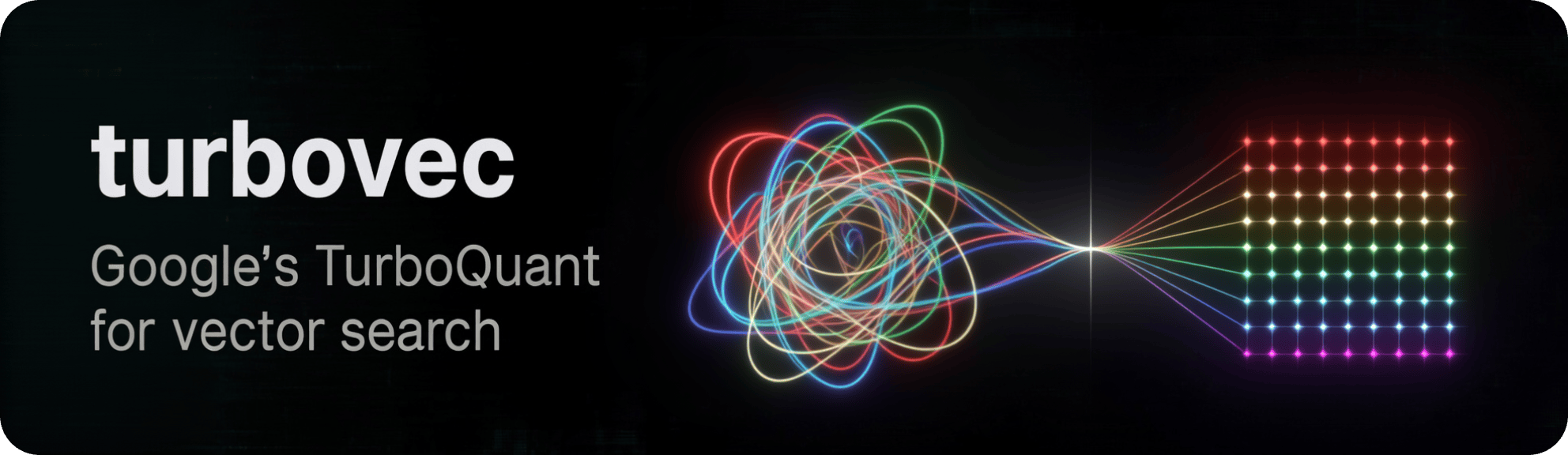
A lot of people ask how do you run AI with 10m vectors on PC and everything works. This is how we shrink the data. 🚀 10 Million vectors in just 4 GB RAM — without sacrificing recall or speed.
Vector search is becoming a major bottleneck in RAG and enterprise search stacks. As embedding corpora grow into millions of documents, standard FP32 storage quickly drains RAM and inflates infrastructure costs.
Enter turbovec - a high-performance vector index written in Rust (with Python bindings) based on Google Research's TurboQuant algorithm.
Here is why turbovec is a game-changer for production-grade vector search:
- 16x Memory Compression: Uses data-oblivious scalar quantization via random rotation and precomputed Lloyd-Max codebooks. A 10M document corpus (1536-dim) shrinks from 31 GB to 4 GB.
- Zero Training Phase: Instant online ingestion. No vector training steps, no parameter tuning, and no expensive index rebuilds as your corpus scales.
- Blazing Fast SIMD Kernels: Features hand-written NEON (ARM) and AVX-512BW (x86) kernels that beat FAISS IndexPQFastScan on throughput across key configurations.
- Zero-Loss Search-Time Filtering: Supports bitmask/allowlist candidate filtering directly inside SIMD blocks before LUT lookup - avoiding over-fetching or recall hits.
- Purely Local & Air-Gapped: Runs entirely in-process or on-prem with no external APIs, making it perfect for strict privacy and enterprise governance frameworks.
It also comes with drop-in integrations for LangChain, LlamaIndex, Haystack, and Agno.
Check out the repository and benchmarks:
#VectorSearch #Rust #Python #MachineLearning #RAG #OpenSource #SoftwareEngineering #AI


